⏱ 10 min read
Overview of the January 2026 Disbursement Cycle
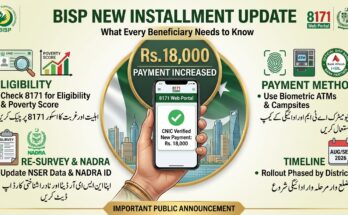
8171 BISP New Update: January 2026 marks a pivotal “Mega-Month” for the 8171 BISP New Update as the government officially rolls out the first quarterly payment of the year. Following recent federal adjustments to combat inflation, the standard Benazir Kafaalat installment has been maintained at Rs. 13,500, with many beneficiaries seeing an increase to Rs. 14,500 depending on their specific eligibility category. This cycle is particularly significant because it is not just a single payment; it is a synchronized release of multiple financial streams aimed at providing a comprehensive safety net for Pakistan’s most vulnerable families during the harsh winter season.
The “Mega-Month” Strategy
The January disbursement is designed to be a “high-impact” release. For the first time, the government is aiming to process 5 different types of installments simultaneously. This means a single beneficiary household could potentially receive their Kafaalat cash, educational stipends (Taleemi Wazaif) for their children, and health-related bonuses all within the same week. By clustering these payments, BISP is ensuring that households have a significant lump sum to manage major expenses like school fees, healthcare, and winter fuel costs, rather than receiving small, fragmented amounts throughout the year.
Key Features of the 8171 BISP New Update:
- Official Amount: The base Kafaalat stipend is confirmed at Rs. 13,500, with a planned rollout in two major phases across all provinces.
- Digital Integration: This cycle marks the nationwide shift toward the Social Protection Wallet, allowing women to receive funds directly on their BISP-linked SIMs.
- Priority Groups: In this January cycle, BISP is prioritizing widows, elderly citizens, and households that missed their late-2025 installments due to technical errors.
- Phase-Wise Rollout: To prevent overcrowding at ATMs and centers, payments are starting in South Punjab, Balochistan, and Interior Sindh before expanding to major urban hubs like Lahore and Karachi.
This month is more than just a routine payout; it is a test of the new digital infrastructure. By staying informed through the 8171 portal, beneficiaries can navigate this busy disbursement period with ease and security.
The 5 Different Installments You Can Receive This Month
In January 2026, the BISP payment structure has become more comprehensive, allowing eligible households to receive up to five different types of financial support in a single month. This “multi-stipend” approach is designed to provide maximum relief to families during the winter season. Understanding which categories you qualify for is key to ensuring you withdraw your full amount from the 8171 system.
1. Benazir Kafaalat (The Base Payment)
This is the core quarterly installment for registered women. Starting in January 2026, the standard amount has been officially increased from Rs. 13,500 to Rs. 14,500. This base payment forms the foundation of the January disbursement for over 9.3 million families.
2. Benazir Taleemi Wazaif (Double Stipends)
If your children are enrolled in the education program and have maintained 70% attendance, their quarterly stipends will be added to your account. Many families are receiving “Double Payments” this month because the system is clearing arrears from the previous quarter alongside the new January-March installment.
3. Benazir Nashonuma (Health & Nutrition Bonus)
Pregnant women and mothers of children under two years of age receive additional health stipends.
- For a Boy Child: Rs. 2,000 per quarter.
- For a Girl Child: Rs. 2,500 per quarter.
- Health Bonus: An extra Rs. 500 is often included for the mother’s travel expenses to the Nashonuma centers.
4. Arrears (Previous Dues)
If you missed a payment in late 2025 due to a “Technical Error,” “Biometric Failure,” or “Blocked Account,” the January cycle is designed to automatically credit those Previous Dues (Baqaya). This is why some women are seeing total amounts exceeding Rs. 25,000 on their 8171 status.
5. Fuel & Winter Subsidy (Special Relief)
Under new federal directives for 2026, a one-time winter fuel subsidy of Rs. 2,000 is being tested in high-altitude and colder regions (such as parts of Balochistan, KPK, and AJK) to help low-income families manage heating costs.
8171 BISP New Update: Payment Summary Table for January 2026
| Installment Type | Estimated Amount | Eligibility Requirement |
| Kafaalat | Rs. 14,500 | Registered & Active in NSER |
| Taleemi Wazaif | Rs. 1,500 – Rs. 4,500 | 70% School Attendance |
| Nashonuma | Rs. 2,000 – Rs. 3,000 | Health Center Verification |
| Winter Subsidy | Rs. 2,000 | Climate-Specific Districts |
Updated Eligibility Criteria for January Payments
In January 2026, the Benazir Income Support Programme has introduced a more rigorous digital audit to ensure that the Rs. 14,500 installment reaches only those who meet the updated poverty standards. The government is no longer relying on decade-old data; instead, eligibility is now strictly tied to the “Dynamic Registry” and a real-time Poverty Means Test (PMT) score. If your information has not been updated in the last three years, your payment may be temporarily held until you complete a re-survey.
Also Read: BISP 8171 Web Portal Reopens 2026: How to Check Your 13,500 Payment Status
The 2026 PMT Score Threshold
To qualify for the 5 new installments this month, your household’s PMT score must generally fall below 32. However, for specific bonuses like the Nashonuma (Health) stipend, the threshold is slightly more flexible.
- Score 0–25: Eligible for full Kafaalat, Taleemi Wazaif, and extra subsidies.
- Score 26–32: Eligible for standard quarterly Kafaalat and education stipends.
- Above 32: Likely to be marked as “Ineligible” or placed on the “Exit List” for the 2026 cycle.
Key Mandatory Requirements
To remain active in the 8171 system this January, you must satisfy these four pillars:
- Valid & Original CNIC: Expired cards are the #1 reason for “Verification Failed” messages. Renew your CNIC at NADRA immediately if it has expired.
- Linked Mobile SIM: The mobile number in the BISP record must be registered on the beneficiary’s own CNIC. If you are using a SIM registered to your husband or brother, the system will block your Digital Wallet.
- Income & Asset Check: The 2026 audit cross-checks with the Excise and Taxation department. If any family member owns a vehicle or has traveled abroad frequently, the CNIC will be flagged.
- No Government Employment: No member of the registered household should be a permanent government employee or receiving a state pension.
Expert Alert: If you receive a “933 Error” when checking your status, it means your data is unverified or your Dynamic Survey is overdue. Visit the nearest BISP Tehsil Office with your children’s B-Forms and a recent utility bill to refresh your record and unblock your January funds.
How to Check Your CNIC on the Reopened 8171 Web Portal
For the January 2026 disbursement, the government has officially updated and reopened the 8171 Web Portal, making it the most reliable tool for tracking your 5 new installments. With the introduction of the Social Protection Wallet, the portal now provides more than just an “Eligible” or “Ineligible” status; it offers a detailed breakdown of your Poverty Means Test (PMT) score and the specific date your funds will be available for withdrawal.
Step-by-Step Guide to Online Verification
To check your status from home without visiting a crowded BISP office, follow these precise steps:
- Visit the Official Link: Open your mobile browser and go to 8171.bisp.gov.pk. (Ensure you are on the .gov.pk domain to avoid fake sites).
- Enter Your CNIC: Input your 13-digit Computerized National Identity Card number accurately, without any spaces or dashes.
- Security Captcha: You will see a 4-digit code in an image. Type these numbers into the box provided to prove you are not a bot.
- Click “Submit” (Maloom Karein): The system will instantly display your result.
Understanding Your January 2026 Portal Results
The 2026 portal uses specific terms that every beneficiary should understand:
- “Eligible (Ahal):” Your Rs. 14,500 has been approved. If the status also shows “Payment Released,” you can proceed to an ATM or Digital Wallet.
- “Under Verification:” Your data is currently being cross-checked with NADRA. Re-check the portal after 7 days.
- “Dynamic Survey Required:” This is a high-priority alert. It means your 3-year survey period has expired, and you must visit a Tehsil office to avoid a permanent block on your January payments.
The 8171 SMS Alternative: 8171 BISP New Update
If you do not have an internet connection, you can still use the 8171 SMS service. Simply type your CNIC and send it to 8171. While this method is faster, it provides less detail than the web portal. For the January cycle, it is highly recommended to use the portal at least once to confirm your PMT score, as this determines whether you receive the additional 4 bonus installments alongside your Kafaalat stipend.
New Digital Wallet Withdrawal vs. Traditional Retailers
The January 2026 payment cycle marks a historic shift in how beneficiaries receive their funds. For years, women had to visit crowded “campsites” or local retailers, often facing long waits and the risk of illegal deductions. This month, BISP has officially introduced the Social Protection Wallet and expanded its partnership with six major banks to ensure the full Rs. 14,500 reaches you safely. However, because this is a transition period, both the new digital system and the traditional agent-based methods are working side-by-side.
Withdrawing via Digital Wallet (The New Way)
If you are in a “Pilot District” (such as Faisalabad, Multan, or Hyderabad) or have received a specialized BISP Digital SIM, your money is now mobile.
- Ease of Access: You can withdraw your cash from any JazzCash or EasyPaisa agent or use the money directly to pay for utilities and mobile top-ups.
- Full Payment Guarantee: Since the money is in your own digital account, no retailer can force a “fee” on you. You simply provide your CNIC and registered mobile number, perform a quick biometric scan, and collect your full amount.
Withdrawing via Traditional Retailers (The Old Way)
In areas where the digital wallet is not yet fully active, the HBL Konnect and Bank Alfalah retailer network remains the primary source.
- Safety Protocol: When visiting a shop or camp, always ask for a printed receipt. In 2026, the system records every transaction digitally; if an agent claims the “machine is down” but asks for your thumbprint, do not comply.
- Biometric Security: ATMs remain the safest “Traditional” method. Visit any HBL or Bank Alfalah ATM, select the BISP/8171 option, and use your thumbprint to withdraw your cash without any human interference.
Comparison: Which Method Should You Choose?
| Feature | Digital Wallet (Mobile) | Retailer/Camp Agent |
| Deduction Risk | 0% (Controlled by you) | High (Risk of agent fraud) |
| Wait Time | None (Withdraw 24/7) | High (Long queues) |
| Verification | OTP + Biometric | Biometric only |
By embracing the Digital Wallet in January 2026, you are not just getting your money; you are gaining financial independence and protecting your family’s rightful support from corruption.
Frequently Asked Questions (FAQs)
Q1: Why is my January payment showing as Rs. 20,000+ on the 8171 portal?
Ans: This is likely because you have qualified for multiple installments. This can include the base Kafaalat amount (Rs. 14,500), your children’s Taleemi Wazaif (educational stipends), and any arrears (missed payments) from late 2025. The portal shows the “Total Combined Balance” available for withdrawal.
Q2: Can I use my existing personal JazzCash account for the BISP January payment?
Ans: Not yet. You cannot manually link a personal account. You must use the BISP-issued Digital SIM or the official Social Protection Wallet account that BISP creates for you. Always wait for an official SMS from 8171 before attempting to withdraw via a mobile app.
Q3: What should I do if my January payment is “Blocked” due to an expired survey?
Ans: If the 8171 portal says “Survey Expired,” your payment is on hold. You must visit your nearest BISP Tehsil Registration Center to complete the Dynamic Survey. Once your household data is updated and your PMT score is re-verified, your blocked January funds will be released in the next month’s batch.
⚠️ Scam Warning: Protect Yourself
- BISP never charges any fee for registration, status check, or payment collection.
- Only trust SMS sent from the number 8171; any other number is a scam.
- Never share your CNIC or PIN with anyone outside an official BISP counter.
- Only use the official website: 8171.bisp.gov.pk. Never trust other URLs.
- Do not pay agents or middlemen — BISP registration is completely free.

Written by Ch ImRaN
"Ch Imran writes on updates from Bisp and government schemes to ensure that every Pakistani gets accurate, verified information."